The Crown
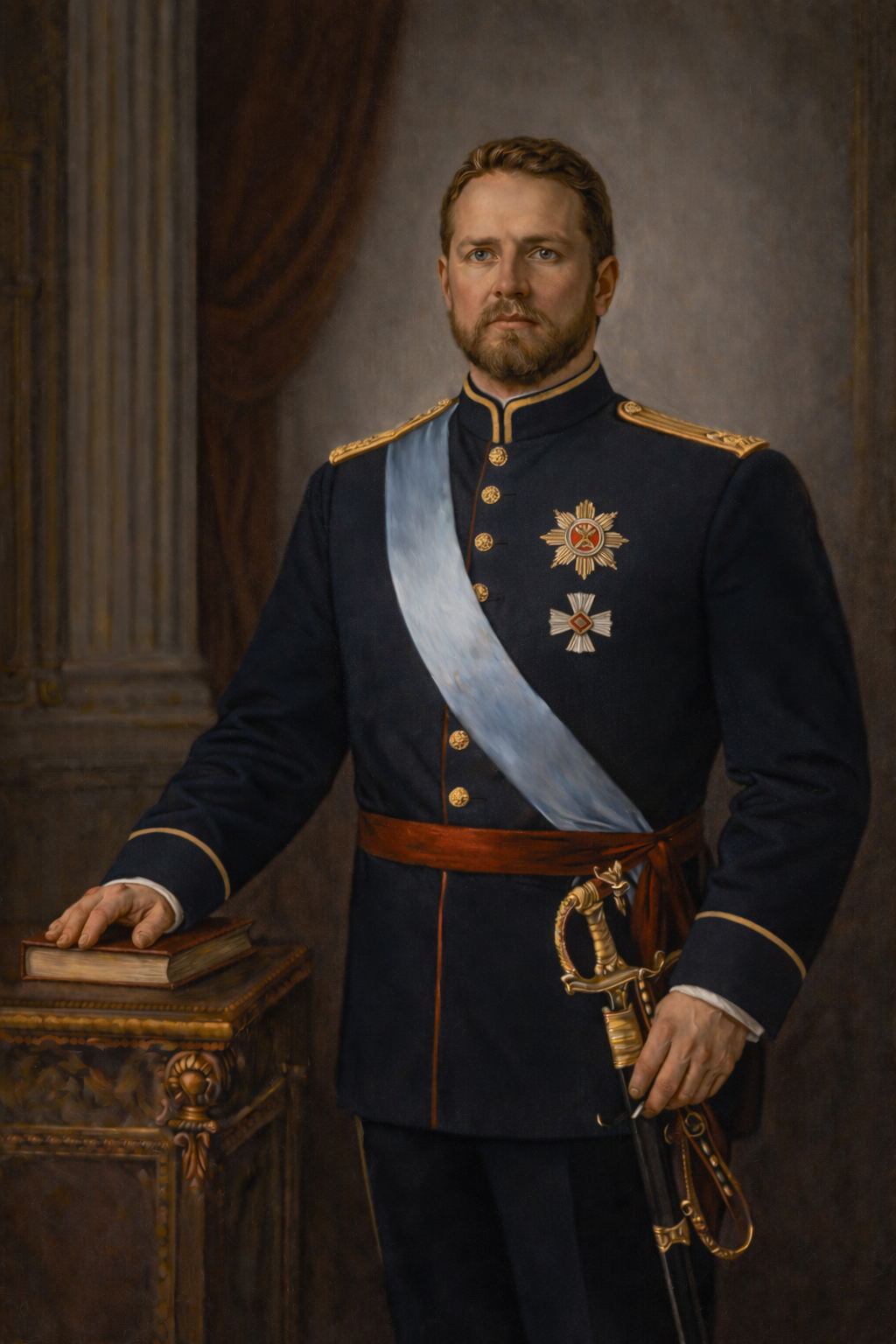
Article 7 of the constitution states that “The Throne is the fount of all State power and honour, which is exercised by and granted on the highest authority of The Sovereign.” As such, the monarch functions as both the head of state and head of government of Eniarku, serving as the legal embodiment of executive, legislative, and judicial governance — known simply as “The Crown.” In this context, the grand duke also functions as the “chief of state” in his role as Eniarku’s representative to foreign nations and international organizations. While the institutional powers of The Crown are formally vested in The Sovereign as an individual, its functions are exercised in the grand duke’s name together with the Council of State, a concept related to the “fusion of powers” in many parliamentary forms of government.
Grand Duke Alexander is the only monarch in Eniarku’s history, having previously ruled as emperor in 2011 and king from 2015 to 2024. Over the course of his separate reigns as sovereign, the name of the ruling house has changed several times as Alexander attempted to harmonize the distant sides of his family, transitioning from the original House of Augustus-Alexei (during the time of the empire) to the short-lived House of Slava before finally becoming the House of Abbott on 5 December 2016. The current name, similar to the House of Windsor in the United Kingdom, is a reference to the former home of the king in the previously autonomous realm of Shaw, which had been renamed Abbott Palace in August 2017 when Alexander took up semi-permanent residence there. By law, children of the grand duke and his consort, Grand Duchess Elizabeth, will bear the surname “Abbott”, as will other descendants granted the style of His/Her Royal Highness and the courtesy title of Prince/Princess of Eniarku.
Where the constitution is silent on matters related to The Crown, a set of rules known as the Law of the Grand Ducal House governs. This “extraordinary” law — sometimes referred to as “Abbott Law” in reference to the current ruling house — controls the internal affairs of the royal house and its interactions with the state. Per Article 14 of the constitution, the house law generally preempts national law on certain issues related to the monarchy and is the typically the final authority on various titles, honours, and rules of succession. The house law is not public, cannot be amended by the Council of State, and its contents are controlled entirely by the grand duke and members of the royal house.
Quick Links
| Government |
| Council of State |
| Laws |
| Resolutions |